A missing tooth doesn’t stay quiet for long, even when it looks that way. The gap is just what you see; below the gumline, the bone that held that tooth in place begins to lose density almost right away, long before your smile looks any different. That’s the part nobody warns you about at the dentist’s office on the day it happens. Meridian South Family Dentistry helps patients catch these changes early, before a simple fix turns into a complicated one.
This guide walks through the specific, physical warning signs your mouth gives off when a missing tooth replacement is overdue, from the way your bite shifts to what’s actually happening inside your jawbone. Along the way, we’ll break down what the research says about timing, and why waiting rarely works in your favor.
Missing Tooth Problems
An empty socket is never just cosmetic. When you lose a tooth, the things around it start moving, usually in ways you don’t notice as they happen.
Your bite, your neighboring teeth, and even the bone structure beneath your gums all respond to that gap. Recognizing this early is one of the clearest tooth replacement signs, because the longer the space sits open, the more it invites problems that spread beyond that single tooth.
- The tooth opposite the gap can over-erupt, by a small amount, as it no longer meets resistance.
- Neighboring teeth begin tilting inward, closing the space at an angle rather than staying upright.
- Food gets stuck over and over again in the gap, creating a cycle of irritation and plaque buildup that is hard to adequately clean.
Loose Or Shifting Teeth
A tooth that feels the slightest bit mobile is telling you something specific: the structure holding it in place has changed. That doesn’t happen in a day. It progresses slowly, and that is why so many patients do not notice it until it is obvious when eating or flossing.
Shifting teeth don’t drift randomly. They move toward the path of least resistance, which is almost always an open space left by a missing tooth. Left alone, this creates a slow chain reaction across your bite.
| What You’re Feeling | What’s Actually Happening |
| Slight wobble when biting down | Supporting bone or ligament has weakened |
| Teeth appear to be spreading apart | Neighboring teeth drifting into an open gap |
| A tooth feels “out of place” compared to last year | Gradual bite shift from lost tooth support |
| Gumline recession around one tooth | Loss of underlying bone density |
If you’re experiencing any of the above, you might want to have it checked out sooner rather than later, as loose teeth don’t usually tighten up on their own.
Trouble Chewing Food
Chewing difficulty rarely announces itself directly. Instead, it shows up as small workarounds: cutting food into smaller pieces, favoring one side of your mouth, or quietly avoiding foods you used to enjoy without ever really deciding to.
These adjustments happen because your bite force is no longer distributed evenly. A missing or unstable tooth forces the surrounding teeth to absorb pressure they weren’t built to handle alone, and your jaw compensates in ways that eventually become uncomfortable.
Bone Loss Warning
This is the part of tooth loss almost nobody explains at the time it happens. Your jawbone requires the pressure of tooth roots to stay dense; if that stimulation is lost, your body will begin to consider the bone unnecessary and will break it down.
The timeline is faster than most patients expect. Bone loss can take place within days of an extraction, and about 30% of the total bone width lost in the first year takes place in the first 12 weeks. Within a year, patients can lose as much as half the width of the bone that held that tooth.
Jawbone deterioration doesn’t stop after year one, either; it continues at a slower but steady pace of roughly 0.25% to 0.5% per year for the rest of a person’s life if the tooth is never replaced.
The First Six Months
Here is where the most dramatic changes take place. Clinical re-entry studies have reported horizontal bone loss of 29% to 63% and vertical bone loss of 11% to 22% within six months of extraction.
Beyond Year One
Once the initial rapid phase slows, the bone doesn’t recover; it simply shrinks more gradually. In more advanced cases, the thinning ridge can lose 50% to 60% of its original width and height over the years and sometimes make future treatment more difficult if too much time has elapsed.
A gap you can see today is a fraction of the change happening beneath the surface.
Changes In Your Bite
Your bite operates as a balanced system, and it takes surprisingly little to disrupt it. Once a tooth is missing, the way your upper and lower teeth meet begins to shift, sometimes subtly enough that you adjust without realizing it.
That imbalance usually appears as new soreness in your jaw joint, uneven wear on some teeth, or a bite that feels different than it used to. These are not isolated manifestations. They are downstream effects of the same structural hole that causes all the rest on this list.
Gum Health Concerns
Gum health and tooth stability are more connected than most patients assume. Without a root to provide a point of resistance, the tissue surrounding a missing tooth site often has difficulty staying firm, resulting in swelling, tenderness, or gradual recession.
In some situations, gum disease is actually among the tooth loss causes in the first place rather than a byproduct of it. Periodontal disease breaks down the ligaments and bone that keep teeth anchored, which means the two issues frequently arrive together and reinforce each other if left untreated.
Speech Or Comfort Issues
Most people don’t give them enough credit for the work they do in speech, particularly the teeth near the front of the mouth. A gap in that area can cause a subtle whistling noise, a lisp, or trouble in clearly articulating some consonant sounds, particularly in longer conversations.
Comfort issues tend to build gradually too. Patients often describe an ongoing awareness of the empty space, whether that’s their tongue repeatedly finding the gap or a persistent sense that something in their bite feels unfamiliar.
When Bridges Aren’t Enough
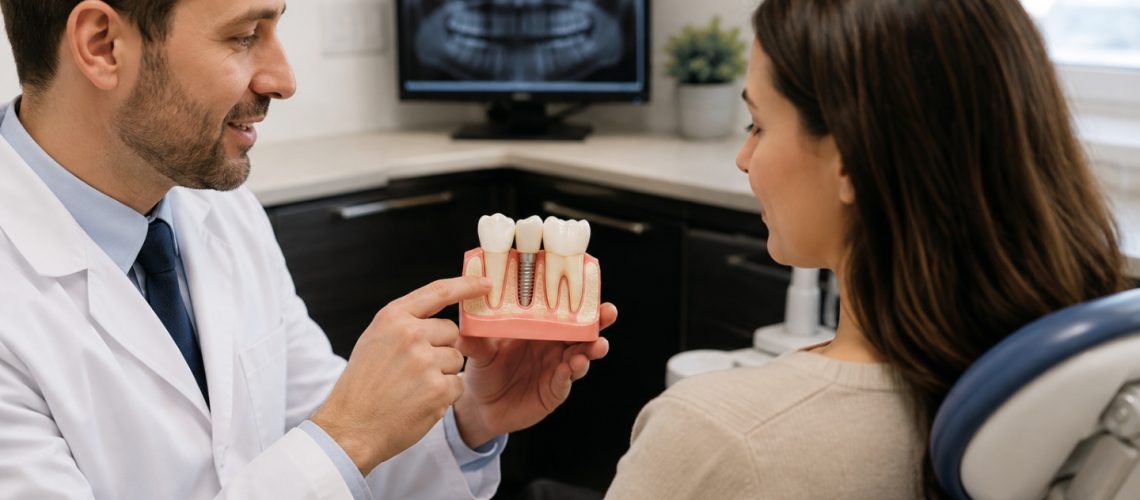
A traditional bridge can look like a complete fix on the surface, but it only hides what’s above the gumline. A bridge is supported by the two adjacent teeth, and often healthy tooth structure is removed to support the bridge.
More importantly, a bridge does nothing for the bone loss happening underneath, since there’s no root replacing the one that was lost. This is where restorative dentistry built around an implant candidate‘s specific needs offers something a bridge simply can’t: a replacement root that keeps the bone active.
| Traditional Bridge | Dental Implant |
| Anchored using neighboring teeth | Stands independently in the jawbone |
| Requires altering healthy adjacent teeth | Preserves surrounding natural teeth |
| Does not stimulate the jawbone | Replicates a natural tooth root |
| Bone loss continues underneath | Helps maintain long-term bone density |
What To Expect Next
If you notice several of these signs, the logical next step is to get a thorough evaluation, not a guess. Our team will assess your bone density, gum condition, and overall bite to determine if you are a suitable candidate for implant treatment, or if preparatory steps make sense first.
Every mouth tells a slightly different story, so treatment plans are built around what your bone and gum tissue actually show, not a one-size-fits-all approach. Patients coming to us from Puyallup and Tacoma often arrive after living with a gap far longer than they realized, and we walk through exactly what a personalized path forward looks like before anything is decided.
Talking To Your Dentist
The most useful thing you can do at this point is simply describe what you’ve been noticing, even details that feel minor. A slight wobble, a change in how food sits in your mouth, or a bite that feels “off” all give us information worth investigating.
We built this practice around honesty, excellence, integrity, and knowledge, and that starts with listening closely before recommending anything. Patients exploring dental implants Puyallup or dental implants Tacoma typically find that one detailed conversation clears up more than weeks of wondering, without any pressure attached to that first visit.
Your Next Step Toward a Stable Smile
The signs covered here, from loose tooth solutions you’ve been putting off to changes in your bite you’ve quietly adjusted around, aren’t isolated annoyances. They’re your mouth signaling that the structure supporting your teeth is changing, and that signal tends to get louder, not quieter, the longer it goes unaddressed.
Meridian South Family Dentistry has spent years helping patients throughout Puyallup, Tacoma, Graham, Orting, Eatonville, and Frederickson, WA understand exactly what these signs mean for their specific situation. Our team evaluates bone health, gum condition, and bite stability with the same care and technology we’d want for our own families, so every recommendation is grounded in what your mouth actually needs rather than a generic checklist.
If any of what you’ve read here sounds familiar, don’t let more time pass while the bone beneath that gap continues to change. Call us at 253-847-4388 to schedule an evaluation and find out exactly where you stand.